
DIY Trenches or Ready-Made Solutions: What Fits Where ?
Why Does the Question “Build It Yourself or Buy It” Arise?
DIY trench terrain vs ready-made trench systems. In the industry of military-tactical games (wargames) and diorama building, terrain plays not only an aesthetic but also a critical functional role. Trenches are a foundational fortification element that directly determines cover mechanics and miniature movement.
Sooner or later, every modeler faces the dilemma: build fortifications independently (DIY) or purchase modular production systems. This decision is influenced not only by budget, but also by gameplay ergonomics, scale accuracy, and long-term durability. In this article, we provide an engineering analysis of both approaches, based on specific measurements and industry standards.
2. DIY Trenches: Advantages and Real Challenges
Advantages of DIY
The primary advantage of building trenches yourself is geometric uniqueness. The creator can integrate a trench directly into an existing landscape, designing nonlinear shapes rarely found in cast modular sections. A modeler is not limited by manufacturer dimensions or design constraints.
DIY also allows the use of accessible materials such as extruded polystyrene (XPS), plaster, PVC sheets, cardboard, clay, or natural components. There are situations where a ready-made trench simply does not fit an already built diorama. In such cases, customization becomes essential.
The key advantage is this: you can build the trench as well as your skill allows and tailor it precisely to your existing layout.
Real Problems of the DIY Approach
Despite creative freedom, DIY trench terrain faces several critical limitations:
Scale Inconsistency:
Without measurement tools and strict standards, maintaining uniform trench depth across 50–100 cm is difficult. A deviation of even 5 mm in 1:35 or 28 mm scale can transform “deep cover” into a shallow ditch where miniatures remain visible, disrupting gameplay logic. Of course, experienced builders can overcome this — but time becomes the main constraint.
Time Investment:
Producing a high-quality 30 cm trench segment (including wall reinforcement, duckboards, detailing, priming, and painting) typically requires 5–10 hours of focused work. For most hobbyists with only 2–3 free hours after work or study, this easily stretches into weeks.
Fragility:
Foam and plaster constructions are prone to chipping. During active gameplay or frequent transport, trench edges wear down quickly, and sandbag textures may detach.
Expert Definition:
“Geometric instability of DIY terrain is the consequence of constructing from available materials (plaster, foam, foil, paper, cardboard, clay, etc.), resulting in the inability to integrate new sections into a unified and expandable gaming system.”
3. Ready-Made Trenches: Advantages of a Systematic Approach
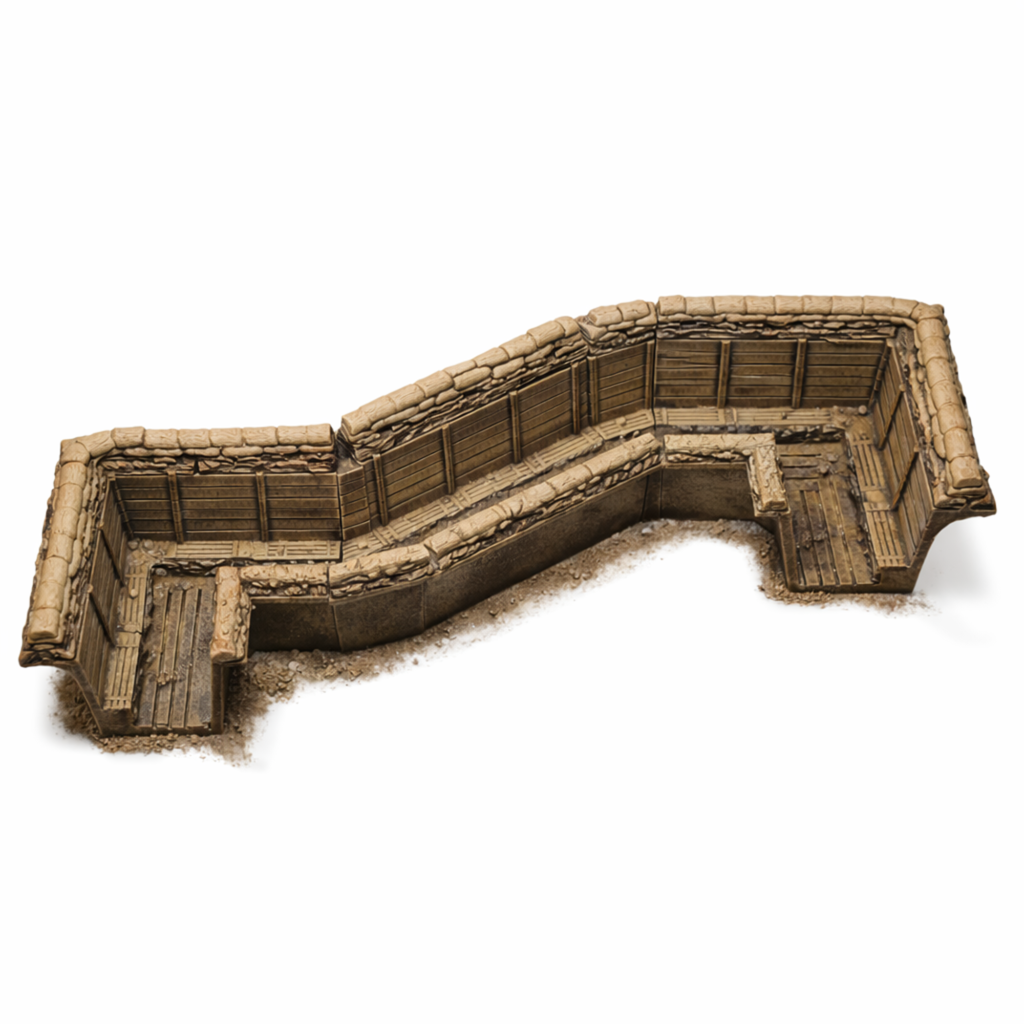
Ready-made trench systems — cast in resin, molded in plastic, or produced via high-resolution 3D printing — are designed using mathematical models aligned with standardized miniature scales.
Geometry and Ergonomics
Trench width is calculated according to standard miniature base sizes (28 mm, 32 mm, 45 mm). This ensures stable positioning inside the trench without models leaning against walls.
Scale Precision
Manufacturers strictly adhere to parameters for 28 mm, 32 mm, and 1:35 scales. Trench depth reflects historical or gameplay prototypes, maintaining fair Line of Sight (LoS) mechanics.
Modularity and Repeatability
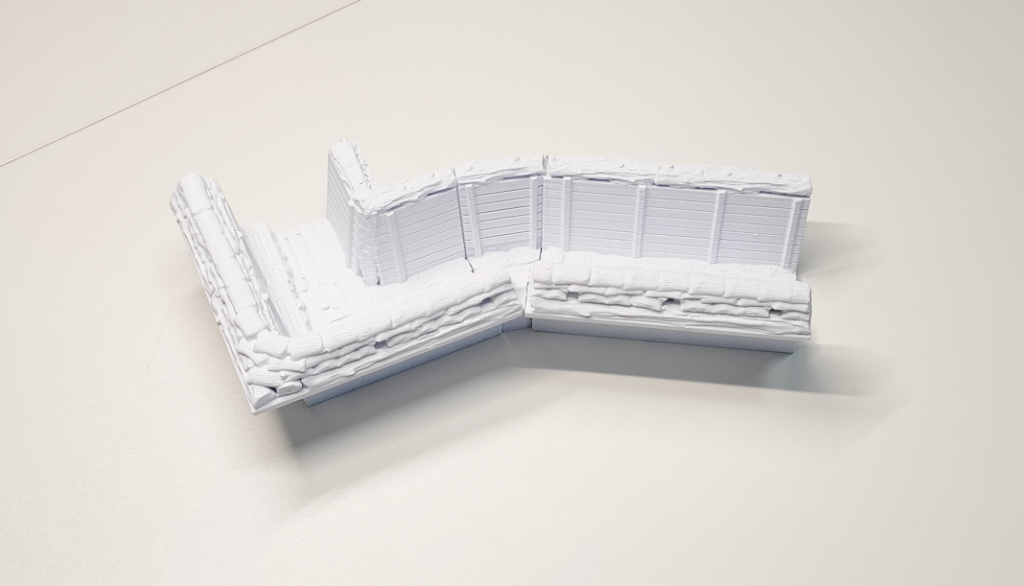
Additional sections purchased even years later will align perfectly with previous modules. This enables unlimited expansion of defensive lines without visual or structural inconsistency.
Stability
Production models have optimized weight distribution and center of gravity, preventing accidental shifting during gameplay phases.
Structural Strength
Modular trenches made entirely of plastic (PLA and similar materials) form a rigid, durable framework resistant to drops and edge wear. If needed, modules can even be cut and modified without compromising structural integrity.
4. Comparison by Key Parameters
| Criterion | DIY Trenches | Ready-Made Solutions |
|---|---|---|
| Preparation Time | High (5–10 hours per 30 cm segment) | Low (1–2 hours for priming and painting) |
| Scale Accuracy | Subjective (skill-dependent) | Standardized industrial precision |
| Durability | Low (sensitive to impact and chemicals) | High (PLA and impact-resistant plastics) |
| Modularity | Limited to one layout | Full system compatibility |
| Material Cost | Low (uses available materials) | Medium to High |
| Repeatability | Nearly impossible | 100% consistency across batches |
5. When DIY Is Truly Justified
Building trenches yourself is rational in two primary scenarios:
Specific Historical or Fantasy Context:
When recreating unique environments not available commercially — for example, anomalous battlefield zones or fantasy-race fortifications.
Budget Prototyping:
For one-time games where aesthetics are secondary to having a physical obstacle on the table.
However, it is important to remember that DIY trenches for dioramas often involve aggressive adhesives and compounds that may deform base materials over time.
6. When Ready-Made Trenches Are the Rational Choice
If you are planning a long-term campaign or building a professional club table, purchasing trench terrain for wargaming becomes a logical decision.
Time Efficiency:
Instead of investing 50 hours building a defensive line, you spend 2 hours on priming and base painting.
Gaming Standardization:
Modular trenches allow rapid reconfiguration between missions — something impossible with permanently glued DIY terrain.
Mechanical Stability:
When trench depth remains consistent across the battlefield, disputes over cover mechanics are minimized.
Expert Definition:
“System-based terrain reduces gameplay friction by eliminating subjective interpretation of cover rules through standardized parapet height and trench depth.”
7. Conclusion: The question is not “cheap or expensive,” but “time or system.” It is better to build something properly and bring your vision to life than to waste kilos of plaster and end up disappointed in the hobby.
The choice between trench terrain DIY and factory-produced systems ultimately comes down to resource analysis. DIY solutions offer creative satisfaction but demand significant time investment and often underperform in durability and consistency.
Ready-made trenches in 28 mm and other scales represent an investment in a cohesive system. They provide visual unity, mechanical resilience, and predictable gameplay. In the long term, a systematic approach proves more efficient, freeing time for painting miniatures and actual gameplay — rather than constant reconstruction.
FAQ: Frequently Asked Questions
In most cases, yes. The 4 mm difference is often offset by base height, though passage width should be checked to prevent base interference.
For 28/32 mm scale, optimal depth is 25–30 mm. This conceals most of the miniature while leaving the head or weapon visible.
Yes. Many hobbyists use modular trench sections as a base and add DIY elements such as barbed wire, debris, and vegetation for personalization.
High-quality resin or plastic products are designed to last for decades. They resist humidity and are compatible with most acrylic paints and varnishes.
Sourses:
Trench warfare
https://en.wikipedia.org/wiki/Trench_warfare
Diorama
https://en.wikipedia.org/wiki/Diorama
Wargame